The Reaper Fired at a Drone. The Real Story Is the Mission Chain.
A New Capability Does Not Start When the Weapon Is Mounted
France recently tested an MQ-9 Reaper firing a Hellfire missile against a drone-type aerial target. It is easy to read that as another C-UAS headline. The more useful engineering story is different: how an existing platform gets a new mission envelope, then has to prove it works as an operational system.
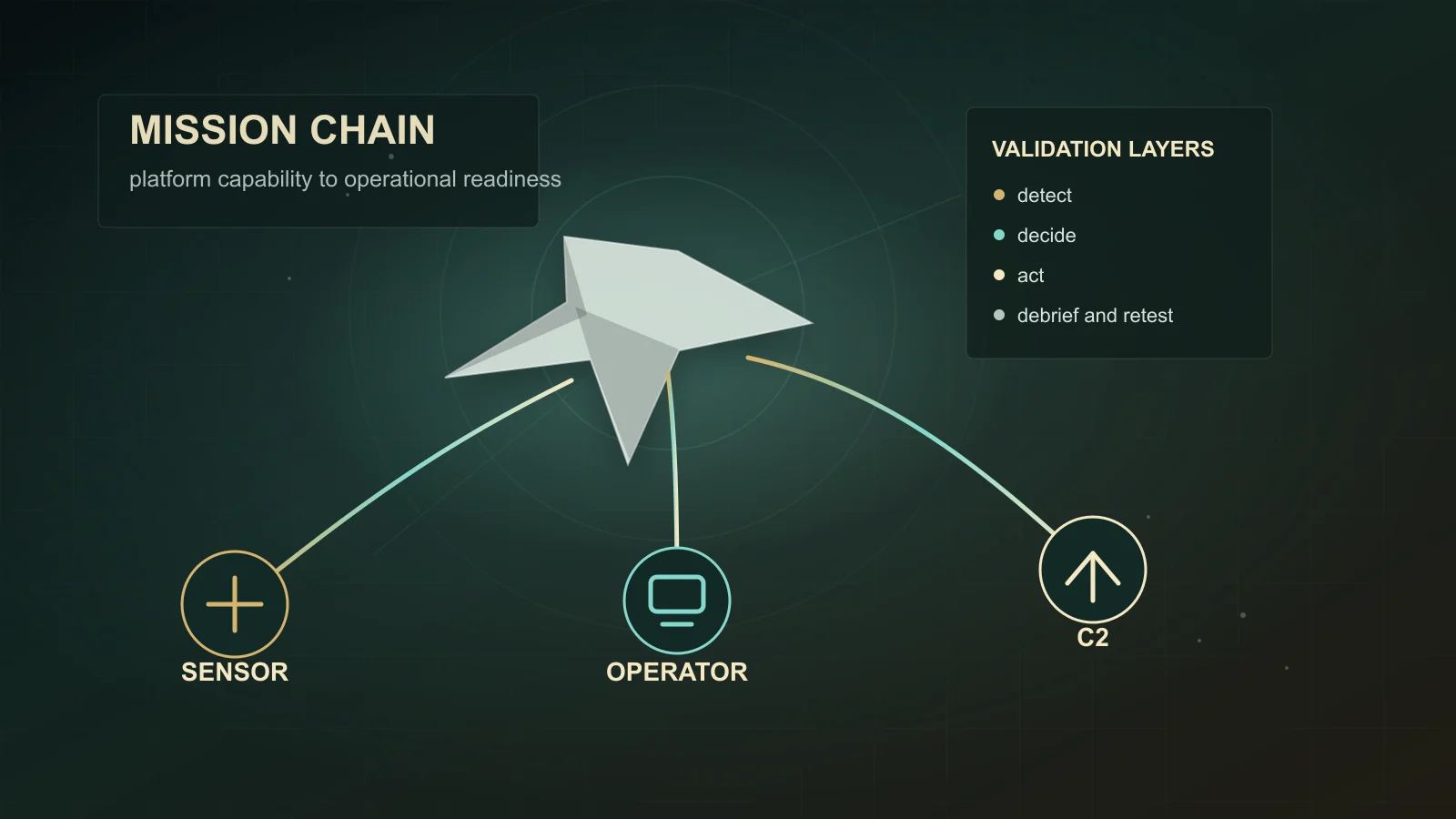
This is not just about the weapon. A Reaper that already performs ISR and strike does not automatically become an effective airborne counter-drone node. The team has to prove that the sensor can support a small dynamic target, the operator gets a usable tactical picture, C2 can support short decision time, and weapon employment fits an airborne target instead of a familiar ground target.
Where Programs Slow Down
Many UAV programs look mature too early. The aircraft flies. The sensor works. The weapon exists. The presentation looks convincing. But operational readiness is measured somewhere else: does the whole chain hold together in a realistic scenario, with safety constraints, communications, a changing target, operator responsibility and structured debrief after every attempt?
The same gap appears in much smaller systems. A team can fly a good aircraft, integrate an impressive payload, and still discover in the field that the workflow is fragile, the operator does not trust the display, or the detect-decide-act loop is too slow.
What to Measure
In UAV development, the key question is not only whether it flies. The better question is whether the mission works end to end. Detection, classification, communications, operator display, decision, action, abort logic, debrief and return to the next test are all part of the same system.
That is why this trial matters even for teams building very different platforms. It is a reminder that real integration is not only between components. It is between engineering, operators, procedures and field conditions. That is where operational readiness is built.
Related reading
Interceptor UAV Trials Become Interesting When Teams Repeat Them
Dedicated crews, repeated interception runs and operator training say more about emerging capability than the interceptor headline itself.
Read ArticleMoving a Capability Airborne Changes More Than the Payload Mount
Adapting an established system for airborne use sounds straightforward until power, cooling, interfaces, crew workflow and mission context all change at once.
Read ArticleThe Interesting Part of a UAV Demo Flight Is What It Hides
A successful demonstration says very little by itself. The engineering value starts when teams ask how quickly the integrated system can absorb change and keep learning.
Read ArticleExpanding the mission envelope of an existing UAV?
We can help build a validation plan that measures the full mission chain, not only the flight or the new component.
Message Nimrod